|
Load Response Programs
With major upheavals in the electricity industry over the past several years, system operators are seeking ways to improve reliability. One method that is being adopted in some regions provides payments for providing electrical capacity during periods when the demand on the power grid is becoming critical. This capacity can be provided either through generation of load shedding.
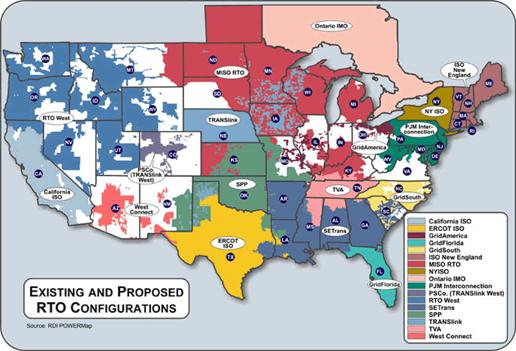
These curtailment programs are normally administered by the Regional Transmission Organizations (RTO’s). RTO’s manage the nation’s electrical grids to provide reliable electrical power by balancing loads and generation. A map of the RTO’s is presented below.
Regional Transmission Organizations
Source: Federal Energy Regulatory Commission (FERC), updated November 18, 2003
Major changes are currently taking place in many of the RTO configurations. While load response programs are being studied and considered by many RTO’s, active programs are in place in the better established RTO’s of the Northeast. There are also programs in ERCOT (Texas) and California, but these are normally administered by third parties, bid based, and more difficult to quantify.
Load response programs can provide two separate payments; one for actual curtailment and another for making the capacity available. Enrolled customers receive a payment for the capacity that is actually provided during curtailment events. For a quick response (usually 30 to 60 minutes), the payment is typically the higher of $500/MWh ($0.50/kWh) or the real time LBMP (Location Based Marginal Price). Lower payments are sometimes available for load capacity that can be provided with more notice.
Often, the entity offering to curtail must bid a price into the RTO. When needed, the RTO starts by accepting the lowest bids and continues accepting capacity at higher bids until the need is satisfied. All those providing capacity receive the highest price that was actually accepted.
The following chart shows the amount of energy that was offered and accepted into the NY ISO Day Ahead Demand Response Program (DADRP) from July 2001 through March 2003. Note that a relatively small portion of the energy offered was actually accepted.
NY ISO DADRP
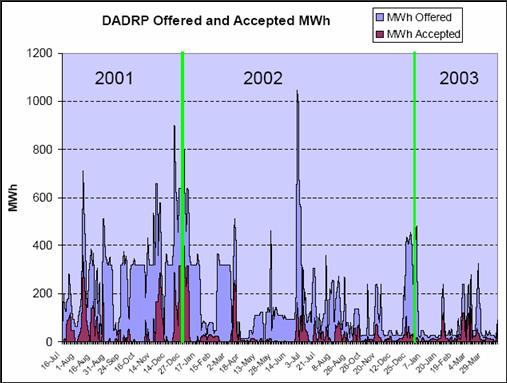
Source: NY ISO[1] web site, www.nyiso.com
Some RTO’s also provide an annual Installed CAPability (ICAP) payment for capacity that is made available for curtailment when needed. These credits vary geographically, not just by RTO but by zone within the RTO. The highest payments are currently $100,000 /MW-year ($100/kW-year) in New York City. Smaller payments are available in certain other markets. These payments are made to participants of the ICAP program whether an event is called or not.
There are many different load response programs tailored to the specific needs of very narrow markets. The following table summarizes current programs that could be applicable within a given markets.
Load Response Programs

Source: RTO web sites
As an example of the payments that might be available for participating in a load response program, assume that 250 kW can be offered in New York City (zone J) through a NY ISO curtailment program.
At $100/kW the capacity payment would amount to $25,000 per year for making the load available for curtailment. In addition, the facility would receive a payment for actual curtailment. In 2002, this facility would have been called to curtail during two events totaling 10 hours. At $500/MWh, this would have resulted in a payment of $1,250. The total curtailment payment would have been $26,250 in 2002.
Conclusion
If you can reduce your dependence on the electrical grid during critical periods, either by shedding loads or operating generation, you may be eligible for financial compensation. Casolari & Associates can determine whether load curtailment can save you money and, if it can, help you realize the savings. We will:
- Identify curtailment programs in your area,
- Determine the net economic benefit of participating,
- Report on programs and the steps necessary to participate, and
- Prepare the necessary applications for participation.
Get started today by contacting Casolari & Associates.
[1] Lawrence, D. 2003. NYISO Demand Response Programs for 2003, New York, New York Independent System Operator
|