|
Electricity Procurement
in a Competitive Environment
Overview
For decades, electricity was tightly regulated by the states and could only be purchased from the local utility company. That is now changing. During the 1990’s a movement started to deregulate the electric industry and open the market to retail competition. By the late 1990’s, states were beginning to allow various forms of competition in their retail electricity markets.
Consumers envisioned free and open competition with many companies vying for their business. This competition was expected to result in significantly lower electric prices. The results to date have been mixed at best.
Electricity Business
There are three major components of the electricity business. Traditionally, these three components have been bundled together and supplied to the consumer as “electricity”. With deregulation, the three components are unbundled and furnished separately, often with each component billed separately. The components are:
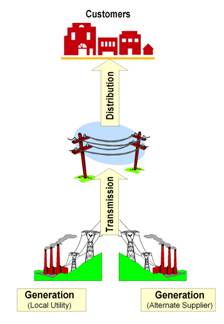
- Generation — Creating electricity at a generating facility or power plant.
- Transmission — Moving very high-voltage power through lines from the generating station to substations where it is converted to a lower voltage usable by consumers.
- Distribution — Carrying the lower voltage electricity through the wires you see along the street from the substation to the facility’s electric meter.
The generation component is normally the only one affected by electrical deregulation. Instead of being owned by a regulated electric company, power generation is owned by independent, competitive companies. These companies are free to sell the power either wholesale (to electric companies or retail suppliers) or retail (directly to the customer). The electricity still travels to the customer through wires owned by regulated transmission and distribution companies.
In many ways, this is similar to long distance telephone service. No matter which long distance retail supplier they select, the service travels through the same wires to the end user.
Deregulation Status
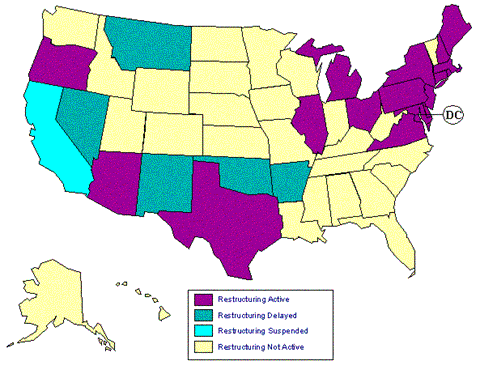
As of October 15, 2003, the Energy Information Administration reports that that twenty-four states and the District of Columbia have either enacted enabling legislation or issued a regulatory order to implement retail access. Retail competition is “active” in 18 of these states.
Status of State Electric Industry Restructuring Activity
|
|
|
|
|
|
Source: Energy Information Administration
|
|
|
In the 18 states with active restructuring programs, it is possible to shop for electricity from multiple suppliers. Unfortunately, the fact that retail access is available does not necessarily mean that it is practical. In a number of states, retail access has been implemented in a manner that makes it difficult for a supplier to compete. As a result, while a customer may solicit proposals, there may not be any responses and there will not necessarily be a benefit to changing suppliers.
Considerations
Once the decision is made to solicit proposals for the electricity supply in a given market, there are a number of factors to consider. Each of these factors has an influence on the overall cost and reliability of the electrical service. Some of these factors are:
Price The cost per kilowatt hour used is the key element of most proposals (usually expressed as cents per kWh). The price might also include transportation, service charges, some taxes and fees. In addition, the price may be either guaranteed fixed for a specified term, or tied to specified market prices.
Quantity The price of the commodity and terms offered will depend on the amount of electricity required as well as the number and location of the sites where it is to be delivered.
Terms The responsibilities of both the customer and supplier must be clearly stated in a Service Agreement. These terms will include any guarantees of price stability, power reliability, the delivery point for pricing purposes, the length of time that the contract will be effective, extension provisions, and additional contract terms.
Special Special provisions of the Service Agreement could include provisions for adding and removing sites, fees for switching suppliers, or fees for switching back to the incumbent supplier.
Billing The billing method must be clearly stated and indicate whether the energy and delivery services will be billed together or separately. Any consolidated billing for multiple sites, and the amount of detail provided, must also be specified.
The proposal, and more importantly the Service Agreement, must clearly present all of this information as well as details such as customer service locations and hours, toll-free phone numbers, complaint handling procedures, and any required fees or deposits.
Risk
As the market for electricity becomes increasingly competitive, electricity pricing may be based on prices set by market forces rather than regulation. Traditionally, the risks associated with rising fuel prices and unexpected changes in demand have been managed by the regulated utility. Some of these costs were passed along to the customer through fuel adjustment charges.
In a deregulated environment, some of this risk might be transferred to the customer. If the customer is willing to bear more risk, the price of service will be lower. The primary risk factors customers could face in today’s environment include electricity prices, fuel prices, demand fluctuations, supply disruptions, transmission disruptions, credit risk, and regulatory risk. The most important thing is to understand the level of risk that is contained in each proposal.
The most realistic way for most customers to manage this risk is to work only with highly rated companies and embed the risk within the commodity purchase contract with the supplier. This is done by calling for fixed ceiling prices that do not vary based on these risk factors and by soliciting proposals only from companies with stable, investment grade, credit ratings.
Conclusion
Shopping for electricity in selected open markets can yield significant savings. The process can be complicated, but well worth the effort. Let Casolari & Associates help by:
- Developing a Requests For Proposals,
- Identifying qualified suppliers,
- Issuing the RFP’s,
- Evaluating the proposals,
- Recommending suppliers and terms, and
- Assisting with contract negotiations.
Get started today by contacting Casolari & Associates.
|